August 2, 2027 Total Solar Eclipse: Maximum, Maps and Meaning
Read the August 2, 2027 total solar eclipse facts and learn why global maximum duration, local visibility and astrological symbolism are different questions.
The August 2, 2027 event is a total solar eclipse. NASA lists greatest eclipse at approximately 10:06 UT and a central duration of 6 minutes 23 seconds at greatest eclipse. That duration is not a promise for every location along the path, much less for places outside it.
Read a global statistic as a global statistic
An eclipse's catalog maximum describes a particular geometry and location. A local observer needs a path map, local contact times and the conditions at their chosen site. Do not use the headline duration as a substitute for those details.
The New Moon phase and greatest eclipse also have separate reference times. A minute-level difference is not necessarily a contradiction; the events are defined differently. Preserve the time standard when comparing sources.
Keep observation planning outside the horoscope
This page does not recommend travel locations or provide solar-viewing safety instructions. Follow the linked NASA circumstances and authoritative observing guidance for those purposes. An astrological sign label does not tell you where totality is visible or how to observe it.
The tropical Moon label at maximum is Leo, while the Lahiri sidereal label is Cancer. State the system before interpreting the event. Treating both labels as interchangeable can produce a reading that appears detailed but rests on inconsistent inputs.
A creative use of the symbolism
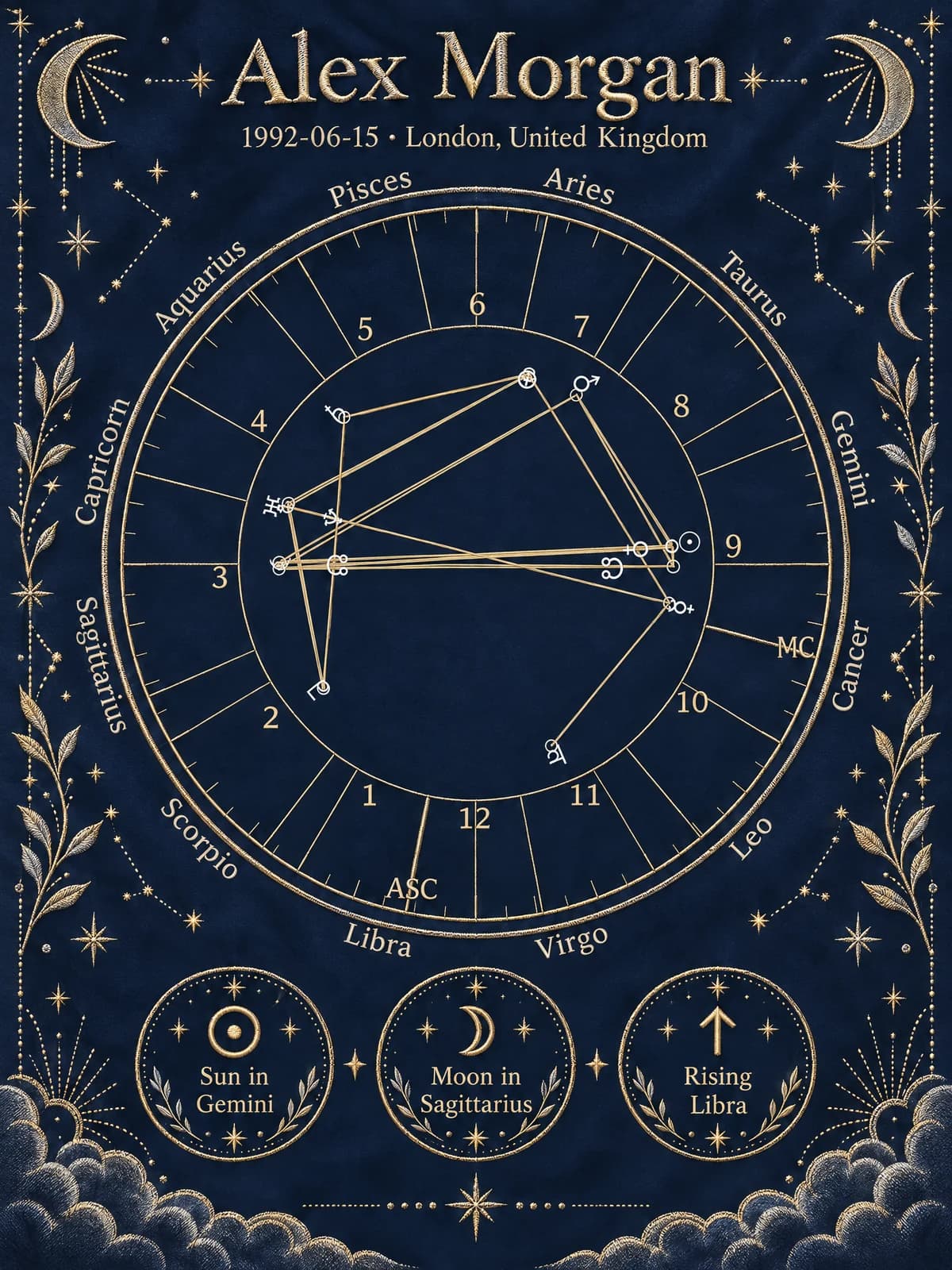
A Leo-themed reflection might ask what you want a public piece of work to express and whether its presentation supports that purpose. For birth-chart art, the factual chart should remain the fixed foundation. An eclipse-inspired palette or border can be a stylistic choice, with a dated caption explaining the inspiration. It should not silently replace natal placements or imply that the owner was born during this eclipse.
Factual reference calendar
The rows below are astronomical reference data, not predictions of personal events. Station and phase times are UTC. Eclipse maxima use the NASA catalog's approximate UT; differences of seconds from future UTC are not resolved here. Convert to your location before using a civil date.
| Date and time | Event | Zodiac label |
|---|---|---|
| 2027-08-02 10:06 | total solar eclipse | Leo |
Sign labels use Western tropical coordinates. This selection is not an exhaustive list of daily aspects. Eclipse labels refer to the Moon's longitude at greatest eclipse, not a geographic visibility region.
Apply the guide to your own chart
Start with a calculated birth chart and record the birth time, birthplace, zodiac and house system. A planet's sign in a general calendar does not tell you its house in your chart. Find the relevant sign on your own wheel or grid, then examine any close contact with a natal planet. House-based examples need a reliable Ascendant; without a known time, leave that part uncertain.
Keep a short comparison record: the astronomical event, the chart placement, the interpretation you considered and what actually happened. Include occasions when the interpretation did not fit. This separates a useful reflection exercise from a story adjusted after every outcome. The 2027 overview and guide to reading a birth chart can help establish the baseline.
If you are making personalized chart artwork, keep the natal chart as the fixed source. Annual transits belong in a separate dated note or companion calendar; replacing natal placements with current ones would describe a different chart.
Boundaries of this reading
A horoscope cannot establish who will marry, become wealthy, fall ill or experience a particular event. Use real circumstances, consent, evidence and professional advice for consequential decisions. A difficult-sounding transit does not make an ordinary day dangerous, and an encouraging one does not remove practical constraints. You can use a symbolic theme to ask a better question without treating it as an instruction.
This article was prepared with AI assistance and source-based checks. It has not received an independent human astrologer's review. Calculation accuracy and interpretive usefulness are different questions; the source record addresses the first, not a guarantee of the second.
Sources and checking the figures
- Total Solar Eclipse of 2027 August 02 — Solar-eclipse type, date, greatest eclipse, and path data.
- Swiss Ephemeris via pyswisseph — Deterministic local event calculation using the dependency already present in this repository.
The astronomical registry was checked against the listed sources. Those sources do not endorse the astrological interpretations on this page. Interpretations are presented as a reflective tradition, not scientific evidence about future life outcomes.
Frequently Asked Questions
Will everyone see 6 minutes 23 seconds of totality?+
No. That is the catalog central duration at greatest eclipse. Local circumstances and visibility vary by location.
Are the interpretations scientifically verified predictions?+
No. The astronomical dates are checked separately. Astrological meanings are a reflective tradition and do not establish what will happen to an individual.
Why can the date differ in my local calendar?+
The reference times use UTC, with approximate catalog UT for eclipse maxima. Convert the event to your timezone; a late-night event can fall on the following local date.
Bring the reading back to you
Where does your own story begin?
Explore a personal preview based on your birth date, time and place. See your Sun, Moon and Rising, then decide whether you want the complete reading and your chosen chart artwork.
- Calculated birth chart
- Personal insights
- Preview before purchase
Your preview is free. The full reading, artwork and downloads are available as a one-time purchase.